Industry4 Apr 20266 min read
The Rise of Agri-Drones: How Indian Farmers Are Adopting UAV Technology
Across Punjab's wheat fields, Andhra's cotton rows, and Maharashtra's sugarcane belts, something is changing. The drone isn't a gadget anymore — it's becoming farm infrastructure.
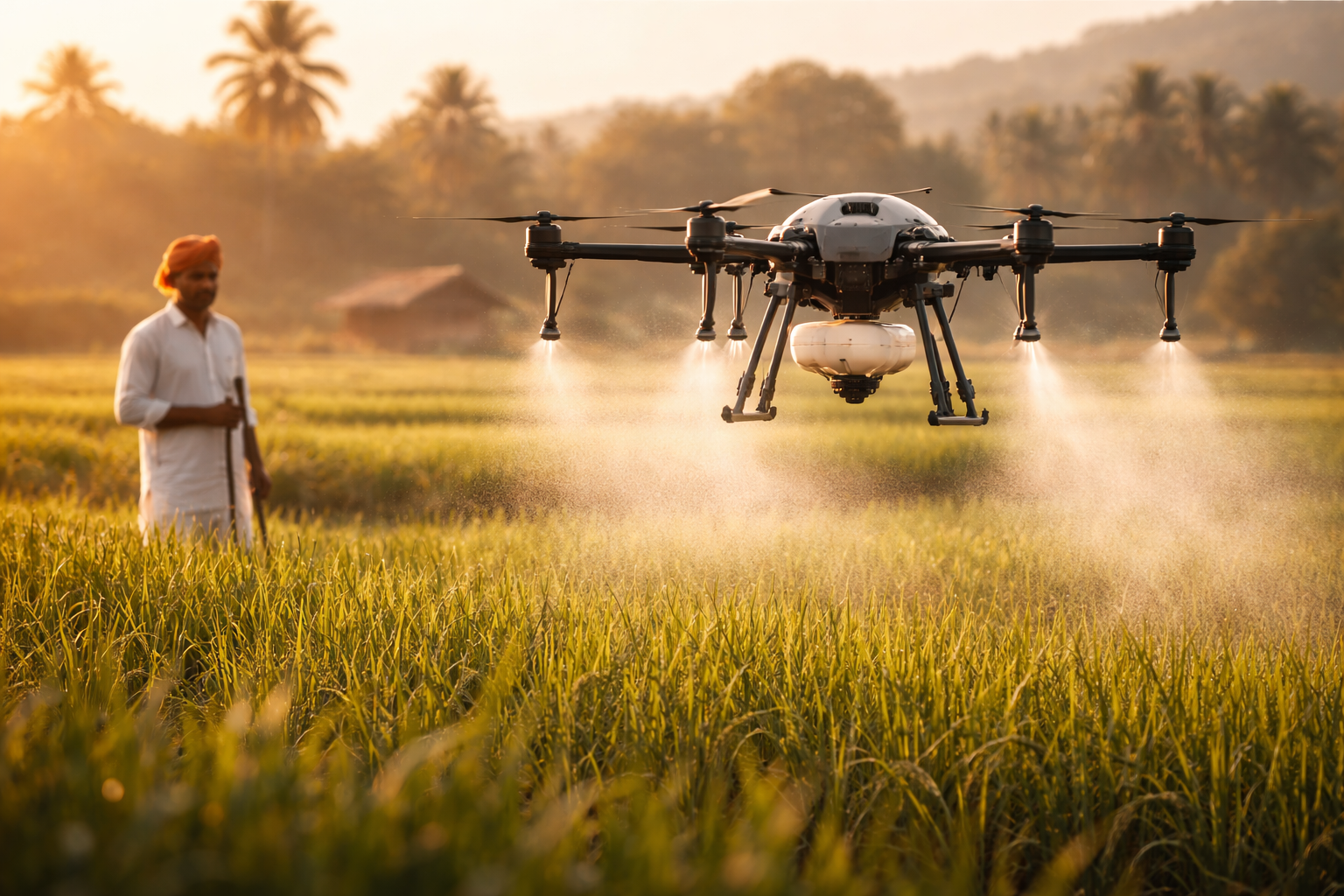
Ranjit Singh has been farming 12 acres of paddy in Ludhiana district for over two decades. He knows his land the way most people know their own face — every low patch that floods in August, every corner where the soil turns sandy and needs extra input, every row that gets hit first when the white fly comes.
Last season, for the first time, he didn't walk those rows with a knapsack sprayer on his back.
A drone did it in 22 minutes.
"Pehle teen din lagta tha," he says. Three days it used to take. Now it's done before lunch.
Ranjit's story isn't unique anymore. Across Punjab, Andhra Pradesh, Maharashtra, Telangana, and Madhya Pradesh, agri-drones are moving from government demonstration plots into actual farm workflows. Slowly, unevenly, and with real friction — but moving.
How We Got Here
India didn't stumble into agri-drones. The path was deliberately constructed — through policy, subsidy, and a set of companies willing to build service infrastructure in places where infrastructure is hard.
The turning point was 2022. The government launched the Kisan Drone initiative under the broader drone policy push, with subsidies of up to 100% for farmer cooperatives, FPOs, and agricultural universities to acquire spraying drones. State governments layered additional incentives on top. The Ministry of Agriculture put drone demonstrations on the agenda of every Krishi Vigyan Kendra in the country.
At the same time, companies like Garuda Aerospace, TechEagle, and a dozen regional operators started building what the government couldn't: last-mile service delivery. Not just selling drones to farmers — actually showing up, flying the mission, and charging per acre.
That service model turned out to be the unlock.
Most Indian farmers — especially smallholders with 2–5 acres — don't need to own a drone. They need access to one. The shift from product sales to drone-as-a-service made agri-UAV adoption economically rational for the first time.
What Agri-Drones Actually Do
For readers outside the agricultural space, it's worth being precise about what these platforms are doing in the field — because "agri-drone" covers a wider range of applications than most people assume.
Crop spraying is the dominant use case right now. A typical agricultural spraying drone carries a 10–16 litre tank, uses centrifugal atomizers or flat-fan nozzles to distribute pesticides, herbicides, or fertilizers, and covers 1–2 acres per battery cycle. The efficiency gains over manual or tractor-boom spraying are significant — particularly in standing crops where ground equipment causes physical damage to plants.
Crop health monitoring is the second wave. Multispectral cameras mounted on survey drones capture NDVI (Normalized Difference Vegetation Index) data — essentially a map of plant stress across a field. A farmer looking at an NDVI map can see exactly where nitrogen is deficient, where irrigation is uneven, or where pest damage is beginning before it's visible to the naked eye. Catching problems at that stage changes the economics of intervention dramatically.
Seed and fertilizer broadcasting is emerging as a third application — particularly for crops like paddy where direct-seeded rice is replacing transplanting in water-scarce regions. Drone broadcasting of pre-germinated seeds is faster, more uniform, and requires far less water than traditional transplanting.
The Numbers Are Starting to Move
India has approximately 140 million farming households. Agri-drone penetration is still a fraction of a percent of that number. But the growth trajectory is steep.
According to industry estimates, agri-drone spraying services covered somewhere between 3–5 million acres in India during the 2023–24 kharif season. That sounds large. Against India's 140+ million hectares of net sown area, it's a rounding error. But it represents roughly 10x growth from two seasons prior.
The economics are becoming clearer too. Drone spraying services are typically priced at ₹400–600 per acre, inclusive of chemicals in some service models. For a farmer paying daily labor wages of ₹400–600 per worker per day, and needing 3–4 workers for 2–3 days to manually spray a medium-sized holding, the drone rate is competitive — especially when factoring in the reduction in chemical waste due to more precise application.
Where It's Working and Where It Isn't
Agri-drones are not working equally well everywhere, and honest coverage requires saying that clearly.
Where it's working well: Punjab and Haryana lead adoption for a reason — large, flat, consolidated landholdings with relatively high farmer income levels and existing exposure to mechanized agriculture. The drone fits into a mechanization mindset that already exists.
Andhra Pradesh and Telangana have seen strong adoption driven partly by state government push and partly by the prevalence of cotton and chilli cultivation — high-value crops where input cost savings translate directly to margin improvement.
Where adoption is slow: Fragmented smallholder regions — parts of Bihar, eastern UP, Jharkhand — face structural challenges. Landholdings of under one acre make per-acre service economics difficult. Terrain in hilly regions of Uttarakhand and Northeast India limits the flat-field playbook most spraying drones are optimized for.
Water availability for drone battery cooling and logistical challenges in remote areas add friction that urban drone companies often underestimate.
The People Making It Work
The agri-drone story isn't just about technology — it's about the people operating it at the ground level.
The government's Remote Pilot Certificate program has trained thousands of young operators, many from rural backgrounds, who are now running micro-enterprises offering drone spraying services in their districts. A certified drone pilot with a spraying UAV can earn ₹30,000–50,000 per month during peak agricultural seasons — a meaningful income in rural India.
This is one of the quietly important parts of the agri-drone story. It isn't just about farming efficiency. It's about creating a new class of rural technology entrepreneurs who earn their livelihood from precision agriculture services.
Organizations like IFFCO and various Farmer Producer Organizations have become aggregators of this service layer — booking drone operators in bulk, standardizing service delivery, and creating the kind of organized market that individual operators struggle to build alone.
What Needs to Happen Next
The agri-drone sector in India has real momentum. But several things need to happen for it to reach its potential scale.
Better data infrastructure. NDVI maps are only useful if farmers have someone to help them interpret and act on the data. The drone is the sensor. The agronomist is the intelligence layer. India needs more of both working together.
Financing for operators. Most drone spraying micro-entrepreneurs are buying their UAVs on credit. Interest rates, working capital gaps during off-seasons, and equipment depreciation are real constraints. Agri-fintech and NBFC products designed for drone operators would meaningfully accelerate the segment.
Standardization of service quality. Right now, the quality of drone spraying services varies enormously. Nozzle calibration, flight altitude, overlap patterns, chemical mixing ratios — there's no enforced standard. A bad spraying job doesn't just waste money; it can damage crops or create pesticide resistance. Industry-level service standards are overdue.
Integration with soil and weather data. The most sophisticated operators are already combining drone imagery with soil health card data and weather forecasts to build prescriptive spraying schedules. This kind of integrated precision agriculture is where the real value lies — and it requires data infrastructure that most of rural India doesn't yet have.
The Larger Shift
What's happening with agri-drones in India is part of a larger transition in how Indian agriculture processes information.
For generations, the knowledge about when to spray, how much to apply, and where the problem is starting lived exclusively in the farmer's eyes and experience. That knowledge is irreplaceable. But it has limits — limits of scale, limits of precision, limits of early detection.
Drones extend that knowledge. They don't replace Ranjit Singh's understanding of his 12 acres. They give him a tool to act on that understanding faster, more precisely, and with less physical cost.
That's not disruption. That's amplification.
And in a country where the average farmer is over 50 years old, where agricultural labor is becoming scarcer and more expensive, and where climate variability is making every input decision more consequential — amplification is exactly what's needed.
Agri-DronesFarmingKisan DroneSprayingRural India
Enjoyed this read?
Get articles like this delivered weekly — technical deep dives, industry news, and drone insights from India.
More in Industry
Industry4 MIN READ
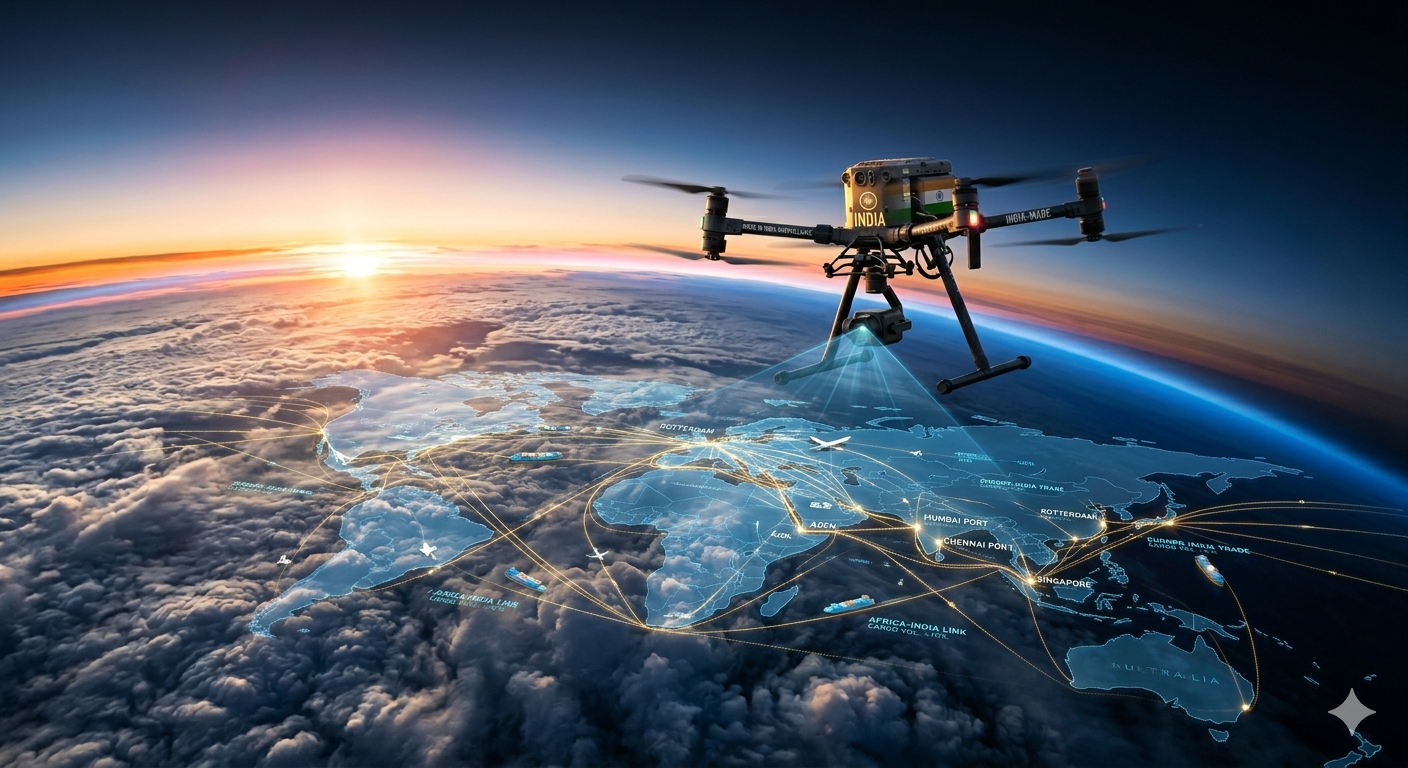
India's Drone Export Ambitions: Can We Compete Globally?
India wants to sell drones to the world. The ambition is real. But so are the obstacles.
By The Drone Post

Industry6 MIN READ
How India's PLI Scheme Is Reshaping the Drone Manufacturing Landscape
The Production Linked Incentive scheme didn't just put money into drone companies — it forced the entire ecosystem to grow up. Here's what changed, what's working, and what still needs fixing.
By The Drone Post
Industry6 MIN READ
UAV Startups to Watch in India in 2026
India's drone industry has moved past the hype. These are the companies quietly building the infrastructure, the platforms, and the hardware that will define the next decade of unmanned aviation.
By The Drone Post