Industry4 Apr 20266 min read
How India's PLI Scheme Is Reshaping the Drone Manufacturing Landscape
The Production Linked Incentive scheme didn't just put money into drone companies — it forced the entire ecosystem to grow up. Here's what changed, what's working, and what still needs fixing.
In August 2021, the Indian government did something it rarely does cleanly: it got the timing right.
The PLI scheme for drones and drone components — worth ₹120 crore over three years — landed at exactly the moment the industry needed a push. The UAS Rules had just been simplified. The drone import ban was in place. And a post-pandemic government was actively looking for sectors where India could build genuine manufacturing depth rather than just assemble foreign components behind a customs wall.
The PLI scheme was the accelerant. What it ignited is still burning.
What the PLI Scheme Actually Does
Before getting into impact, it's worth being precise about the mechanism — because "PLI scheme" gets thrown around loosely.
The Production Linked Incentive for drones isn't a subsidy in the traditional sense. It doesn't hand companies money upfront. It rewards production output. Companies receive incentives calculated as a percentage of incremental sales above a defined baseline — which means the scheme only pays out when manufacturers actually produce and sell.
For drones and drone components, the incentive structure was set at 20% of value addition for drone manufacturers and a sliding scale for component makers. The logic was deliberate: reward domestic value addition, not just final assembly.
This distinction matters. It means a company can't simply import drone parts from China, bolt them together in a shed in Pune, and claim PLI benefits. The scheme is designed — imperfectly, but intentionally — to push value creation upstream into the supply chain.
What Changed on the Ground
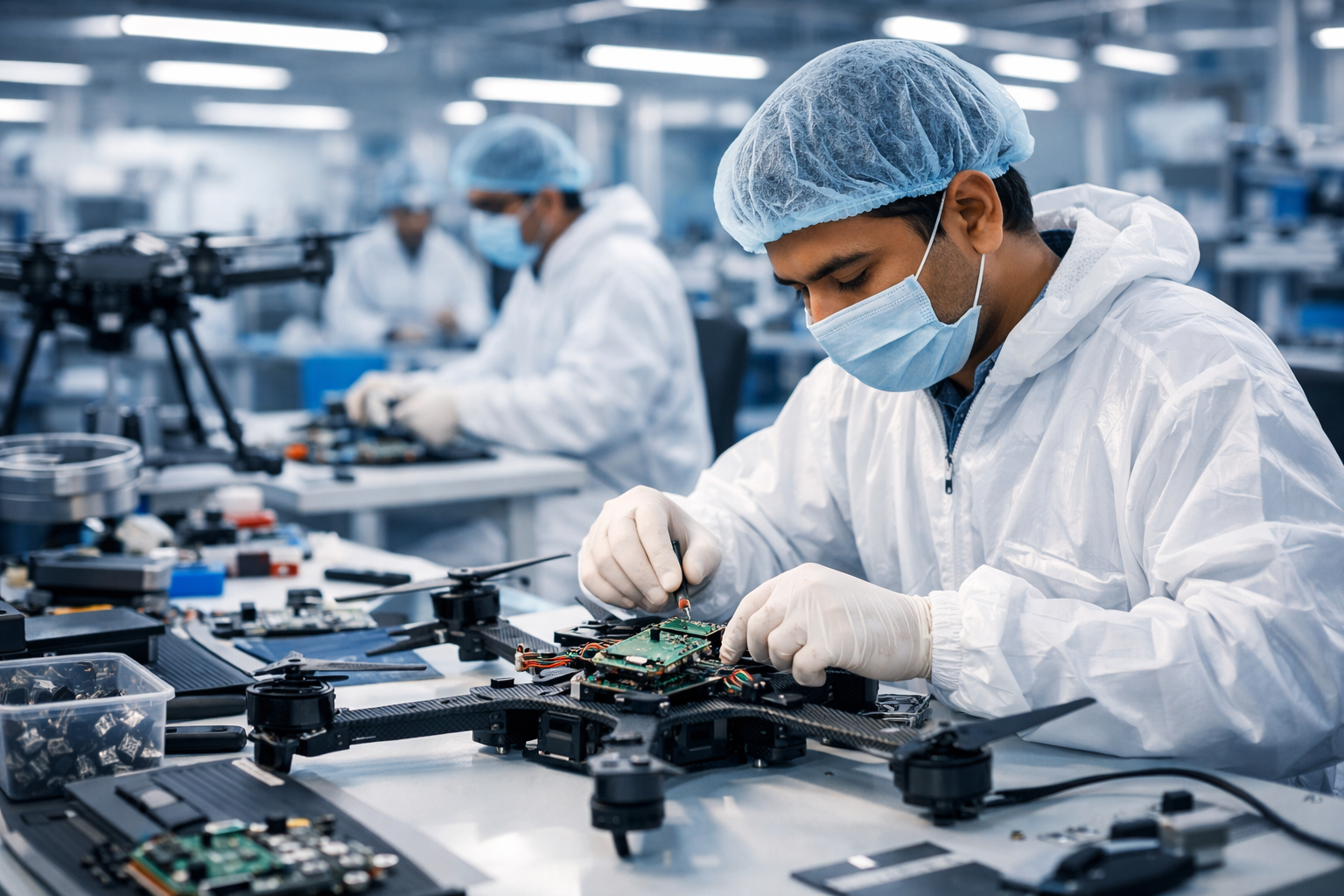
The visible changes came fast. Within twelve months of the PLI scheme's announcement, registered drone manufacturers in India went from a few dozen to over 400. That number includes a lot of noise — small operators, paper companies, and opportunists — but it also includes serious industrial players who moved capacity and capital into India specifically because of the incentive architecture.
The less visible change was more significant: component supply chains started forming.
India had almost no domestic drone component manufacturing to speak of in 2020. Motors, ESCs, flight controllers, propellers, gimbals — the overwhelming majority came from Chinese suppliers, primarily from the Shenzhen ecosystem that had spent a decade perfecting UAV component production.
PLI didn't eliminate that dependency overnight. But it created the economic conditions under which building domestic alternatives became financially rational. You started seeing Indian companies investing in brushless motor manufacturing, LiPo battery cell assembly, and carbon fiber propeller production — not because it was easy, but because the PLI incentive made the unit economics work.
The Companies That Benefited Most
Not every company benefited equally. The PLI scheme rewarded scale, which meant established players with existing production infrastructure got a head start.
IdeaForge was well-positioned — they had the manufacturing infrastructure, the defense certifications, and the sales pipeline to generate the incremental revenue the scheme required. For a company already operating at that level, PLI was a meaningful financial tailwind.
Garuda Aerospace used the scheme differently — as a signal for investor conversations and partnership discussions. The government's explicit backing of the sector, embodied in the PLI scheme, made it easier to raise capital and sign enterprise agreements.
The more interesting story is in the mid-tier. Companies like ideaForge-adjacent hardware manufacturers, component specialists, and regional integrators used PLI to justify capital expenditure that would otherwise have been too risky. A motor manufacturer in Coimbatore. A PCB assembly unit in Noida pivoting to drone electronics. These aren't headline stories, but they're the supply chain depth that determines whether India can sustain a drone manufacturing sector long-term.
What's Still Broken
The PLI scheme did real work. But honest coverage requires acknowledging what it didn't fix.
Import dependency persists at the component level. The most critical, high-precision components — advanced MEMS sensors, certain classes of flight controllers, high-performance imaging chips — are still predominantly sourced from abroad. India has made progress on the assembly and mid-tier component side, but the deep technology components remain a vulnerability.
Quality certification bottlenecks. DGCA's type certification process, while improved, remains slow relative to the pace of hardware development. A company that builds a new platform today may wait 12–18 months for certification — by which time the hardware is already a generation behind. PLI incentivizes production volume, but it can't move certification timelines.
Talent gaps in manufacturing. Drone manufacturing isn't just about capital — it requires specialized manufacturing engineers, quality control professionals, and supply chain managers who understand UAV-specific tolerances. India's engineering talent pool is enormous, but this specific manufacturing knowledge base is thin. Training pipelines haven't kept pace with the industry's growth.
The scheme ended — now what? The original PLI scheme for drones ran through 2025. The industry is now watching closely for the next policy cycle. Companies that built capacity assuming continued government support are recalibrating their plans.
The Bigger Picture: Manufacturing as Strategic Infrastructure
The PLI scheme for drones was never just an economic policy. It was a strategic signal — a declaration that India intends to be a manufacturer and exporter of drone technology, not just a consumer of it.
That strategic logic runs deeper than most people discuss publicly.
Drones are dual-use technology. Every manufacturing capability India builds in the civilian drone sector has direct defense implications. The precision machining, the composite materials work, the electronics assembly — these skills transfer. A country with a mature civilian drone manufacturing ecosystem has a dramatically shorter path to domestic defense UAV production than one starting from scratch.
The PLI scheme was, in part, a defense industrial policy wearing civilian clothes.
What 2026 Looks Like
The Indian drone manufacturing landscape in 2026 is meaningfully different from what existed three years ago. The sector has more players, more production capacity, more domestic component depth, and more international credibility.
But the distance between "meaningfully better" and "globally competitive" is still substantial. Chinese drone manufacturers — DJI in particular — have cost structures, supply chain integration, and technology depth that Indian companies cannot match on a per-unit basis today.
The Indian bet isn't to out-DJI DJI. It's to build sufficient domestic capability to supply the Indian defense and government market independently, while developing export competitiveness in niche verticals — surveillance platforms, agri-drones, inspection systems — where Indian price points and local service networks can compete effectively.
PLI started that process. Whether it finishes it depends on what policy comes next — and whether the companies that received its benefits used the runway to build something that flies on its own.
PLI SchemeManufacturingDGCAMake in IndiaDrone Policy
Enjoyed this read?
Get articles like this delivered weekly — technical deep dives, industry news, and drone insights from India.
More in Industry
Industry4 MIN READ
India's Drone Export Ambitions: Can We Compete Globally?
India wants to sell drones to the world. The ambition is real. But so are the obstacles.
By The Drone Post
Industry6 MIN READ
The Rise of Agri-Drones: How Indian Farmers Are Adopting UAV Technology
Across Punjab's wheat fields, Andhra's cotton rows, and Maharashtra's sugarcane belts, something is changing. The drone isn't a gadget anymore — it's becoming farm infrastructure.
By The Drone Post
Industry6 MIN READ
UAV Startups to Watch in India in 2026
India's drone industry has moved past the hype. These are the companies quietly building the infrastructure, the platforms, and the hardware that will define the next decade of unmanned aviation.
By The Drone Post